
Quick answer
I audited every loss I took and looked for the common factor. It was always the same two: overtrading and oversizing. Then I broke it down one layer deeper. What causes those? Not being able to accept a loss. The fix was not a new setup. It was divorcing how I judge my day from whether I finished green or red. If I am red on the day and I followed my system, that is a win. Once losing became acceptable, the overtrading and oversizing that came from fighting it died off.
Introduction
Everyone who keeps losing wants a chart answer. A better entry, a tighter stop, a new model. I went looking for my chart answer and found a mirror instead. This is the audit that actually moved me forward, and it takes one question repeated twice.
Step one: find the common factor
Pull up your losing trades. Not the one that stung last week, all of them. Then ask the question: what do these have in common?
Mine had two threads running through almost every one:
- Overtrading. Trade after trade, way past the setup count the day actually offered.
- Oversizing. Size that turned a normal loss into a day-ruining one.
Most traders stop here and write "trade less, size down" on a sticky note. It does not work, because those are symptoms.
Step two: ask why again
Take the common factor and break it down one more layer. What is CAUSING the overtrading and the oversizing?
For me the honest answer was: I could not accept the loss. Every revenge trade was an attempt to erase a red number. Every oversized position was an attempt to win the day back in one shot. The chart was never the problem. The refusal to be wrong was.
“I had to disassociate myself from winning and losing, from being green or red on the day. If I am red on the day and I followed my system, that is a win for me.
”Kevin Dhesi · @dhesi_trades
The disassociation
The realization that fixed it: I was letting the P&L decide who I was that day. Green day, good trader, good mood. Red day, bad trader, tilt. That association is the engine of the spiral, because the moment the day goes red, you start trading to repair your mood instead of trading the market.
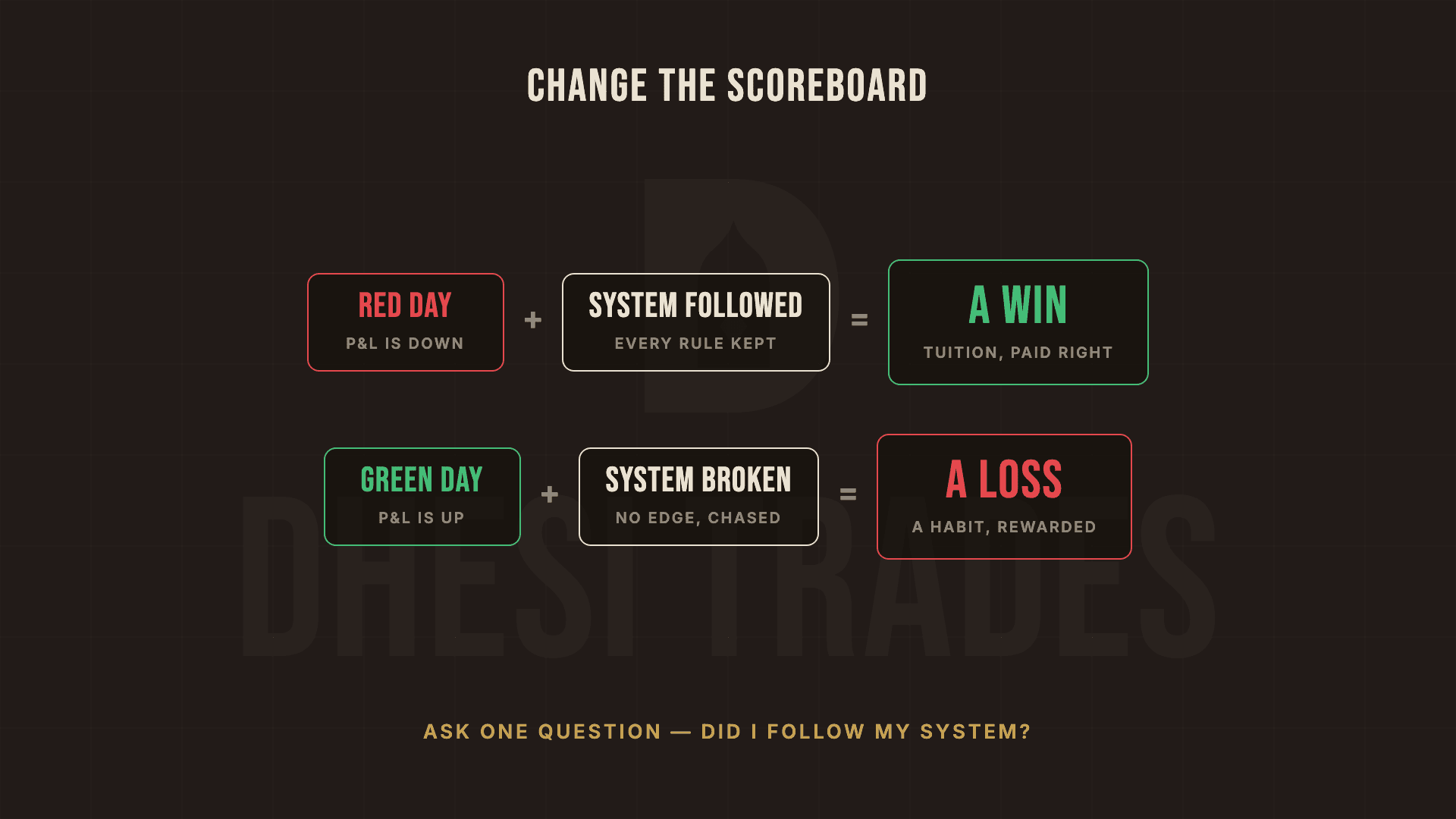
So the scoreboard changed. The question at the close is not "am I green?" It is "did I follow my system?"
- Red day, system followed: a win. That is tuition, paid correctly.
- Green day, system broken: a loss. That is a bad habit getting rewarded.
Change the Scoreboard
 Dhesi Trades
Losing is in the job description
The other half of the realization is simpler and harder: losses are not a malfunction. They are the cost of doing business in this space, and no system removes them.
“Look, I am going to lose. I am going to take losing trades. That is inevitable in this space.
”Kevin Dhesi · @dhesi_trades
Once that lands, a losing trade stops being an emergency that needs fixing right now, this session, with double size. It becomes a line item. The urge to win it back, the engine behind the overtrading and the oversizing, has nothing left to run on.
- Pull every losing trade from the last month. All of them, not the memorable ones.
- Ask: what is the common factor? Write it down. Be specific.
- Ask why one layer deeper. What is causing that factor? Keep going until it is uncomfortable.
- Change the scoreboard: system followed is the metric, not green or red.
- A red day with the rules followed counts as a win. Log it that way.
- Expect losses. Budget for them in size, so no single one demands revenge.
When you are still attached
- You just doubled size after a loss. That trade is about your mood, not the market. Flat is the position.
- Your trade count spikes on red days. Overtrading is loss-refusal wearing a work costume.
- A green rule-breaking day feels good. The scoreboard is still the P&L. Re-run the audit.
- You skip the journal after losing. The audit only works on the trades you least want to look at.
Bottom line
The real reason you keep losing is probably not the setup. Audit the losses, find the common factor, then ask why until you hit something that is not on the chart. For me it was the inability to accept a loss, expressed as overtrading and oversizing. The fix was changing what counts as winning: follow the system, accept the red days, and let the process carry the account instead of the mood.
The size side of the same idea lives in the mental toll of trading, and the discipline that makes it boring on purpose is in rinse and repeat. The system worth following gets built one confirmation at a time on the stream.
Quick check
Three questions, straight from this article. See if it stuck.
0 of 3 answered