
Quick answer
My reversal model is a confluence stack read across three timeframes. YM sweeps the high-probability liquidity, the overnight lows. NQ refuses to follow and instead taps a 15-minute order block and fair value gap. That disagreement is the SMT, and it is still not enough to trade. The trigger lives on the 5-minute: a change in the state of delivery. Entry on the flip, stop at the lows created inside the 15-minute PD array, target the buyside above, the London highs. Same model in reverse for shorts.
Introduction
Everyone wants to catch the reversal. Most people try to do it by buying a low because it looks low. This is the opposite of that: a checklist where every timeframe has to agree before the entry exists. It is the same skeleton as my SMT validation and the time frame confirmation chain, pointed at one job, catching the turn at liquidity.
The liquidity, and the YM tell
Start with where the reversal is even allowed to happen: a high-probability pool of liquidity. In this session, the overnight lows.
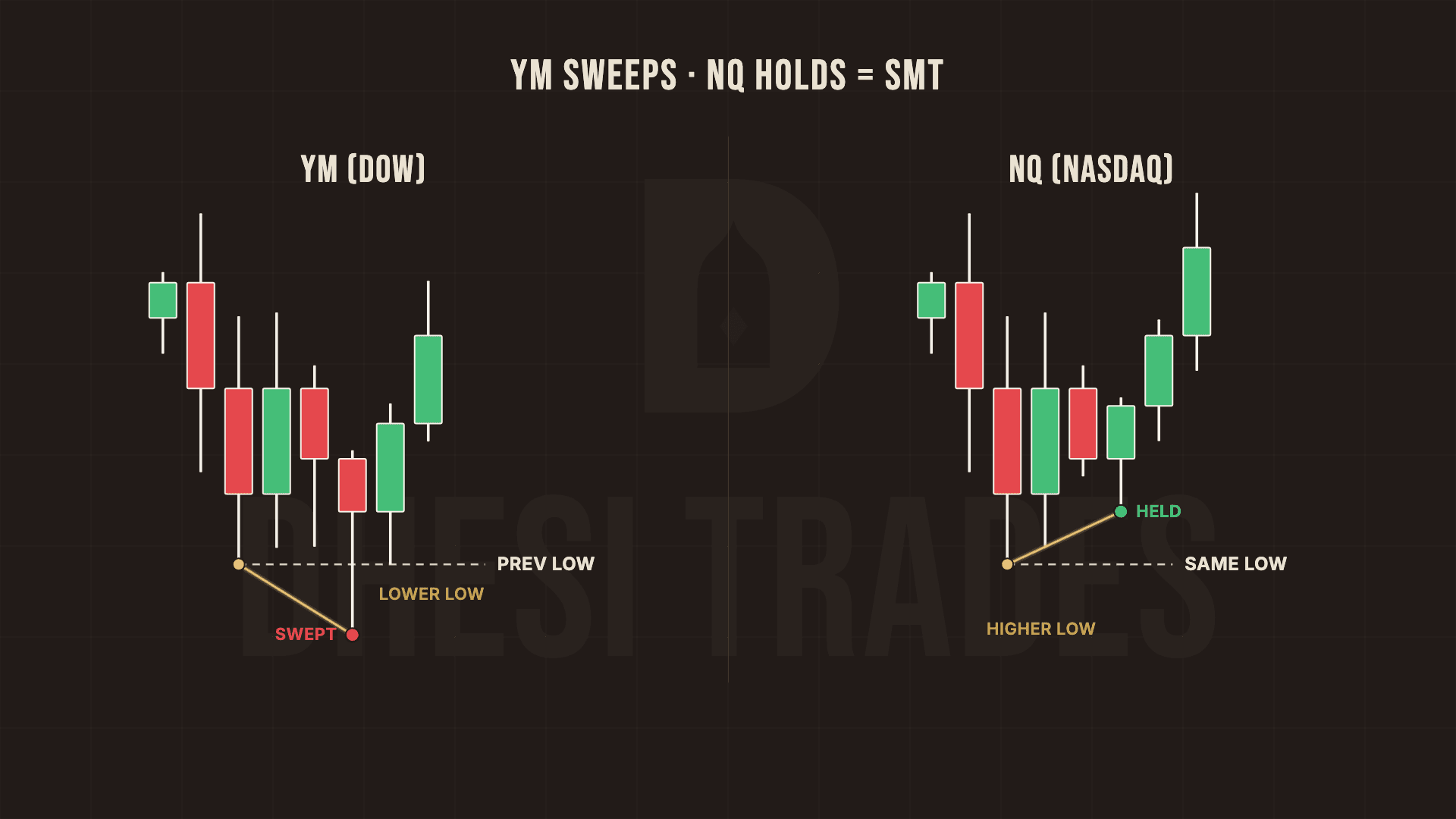
Then watch YM. I use YM for liquidity. At the level, YM does its job and takes the lows. Now the question is what the others do with that sweep.
“YM took the lows. We look at NQ. What is NQ doing? Tapping a 15-minute order block, tapping a 15-minute fair value gap. Now the SMT is there.
”Kevin Dhesi · @dhesi_trades
NQ holds above the same lows and taps into its 15-minute PD arrays instead: an order block stacked with a fair value gap. One index sweeps, the other refuses inside a defended zone. That is the SMT, with a high-probability pool of buyside sitting overhead as the draw.
YM Sweeps, NQ Holds = SMT
 Dhesi Trades
Not enough yet
This is the part that separates the model from a guess. Liquidity swept, PD arrays tapped, SMT printed, draw overhead. Four confluences, and still no trade.
“That is not enough for me to take the trade. Look at the lower time frame. You want to break it down.
”Kevin Dhesi · @dhesi_trades
The 5-minute trigger
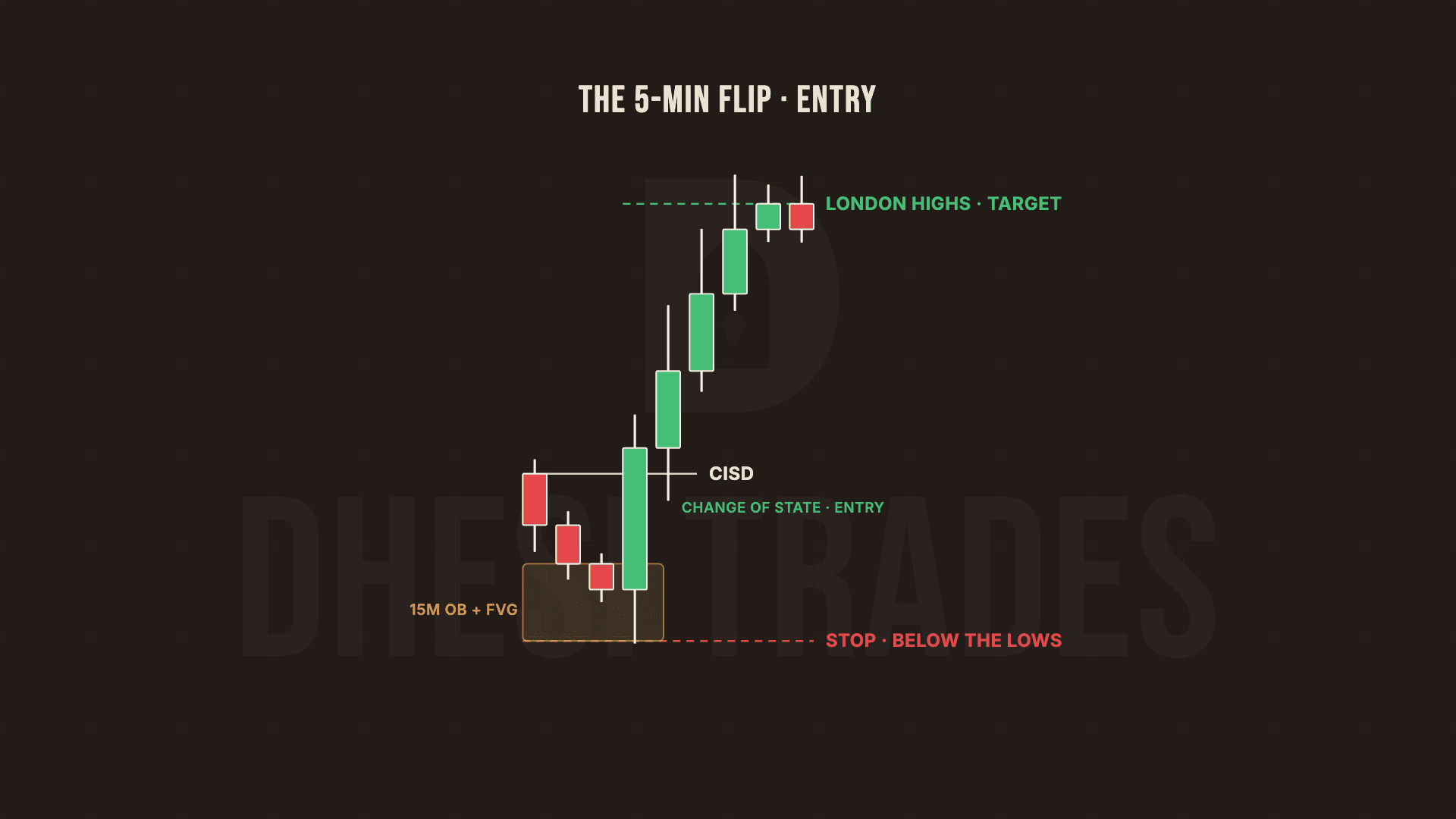
Drop to the 5-minute while price is still working the 15-minute order block and gap. The confirmation is the same one I use for every reversal: the change in the state of delivery. Price stops delivering lower, breaks the down-structure, and starts delivering higher. That flip, inside the higher-timeframe zone, with the SMT at your back, is the entry.
The trade frame writes itself:
- Entry at the change in the state of delivery.
- Stop below the lows created inside the 15-minute PD array. If the zone gives way, the idea is wrong.
- Target the buyside overhead. In this session, the London highs.
The 5-Min Flip. Entry
 Dhesi Trades
The confluence stack
Count what has to line up before the entry prints:
- High-probability liquidity swept: the overnight lows.
- YM versus NQ SMT holding at the level.
- 15-minute PD arrays: the order block and the fair value gap doing the defending.
- 5-minute change in the state of delivery: the flip that confirms it.
- A clean draw: buyside overhead, the London highs as the target.
Higher timeframes aligned with the 5-minute and the 1-minute. That stack is what makes the reversal high probability instead of a hope trade, and the exact same checklist flips upside down for a sell model at the highs.
- Mark the high-probability liquidity: overnight lows, session lows, the obvious pool.
- Watch YM at the level. YM sweeps the liquidity.
- Check NQ. Holding the same lows while tapping a 15-minute order block + fair value gap is the SMT.
- Confirm the draw: buyside overhead worth reaching for.
- Still no trade. Drop to the 5-minute and wait for the change in the state of delivery.
- Entry on the flip. Stop below the lows made inside the 15-minute PD array.
- Target the buyside, the London highs. Reverse every step for shorts at the highs.
When the reversal is not there
- The sweep happens in the middle of nowhere. No 15-minute PD array catching price, no zone, no trade.
- Both indices sweep. No divergence, no SMT, no tell. That is continuation behavior, not a reversal.
- No change in the state of delivery. A tap plus an SMT without the 5-minute flip is still just a level. Wait.
- No draw overhead. A reversal with nowhere to go is a scalp at best. The target is part of the setup.
Bottom line
The reversal is not one signal, it is a stack: liquidity taken, YM and NQ disagreeing, the 15-minute order block and gap defending, the 5-minute flipping its state of delivery, and a clean pool of buyside to aim at. Entry at the flip, stop under the zone's lows, target the London highs. Break it down top to bottom the same way every time, buy model or sell model.
The SMT half of this lives in how I trade SMTs, the timeframe chain in time frame confirmation, and the whole stack runs live on the stream every weekday morning.
Quick check
Three questions, straight from this article. See if it stuck.
0 of 3 answered