
Quick answer
A signal only counts when the timeframe above it agrees. The higher timeframe sets the draw, the middle timeframe confirms the idea, and the lower timeframe times the entry. A 1-minute inversion inside a 1-hour rejection zone is a trade. The same 1-minute inversion in the middle of nowhere is noise. Every timeframe has one job, and the cascade only works top down.
Introduction
The most common mistake I see is traders glued to the 1-minute chart, reacting to every candle, with no idea what the hourly or 4-hour is doing around them. They are trading the ripples and ignoring the tide. Time frame confirmation is the fix: a simple chain where each timeframe validates the one below it before any entry exists. It is the skeleton under every model I trade, from the V4 sweep to inversion to the SMT validation.
Each timeframe has one job
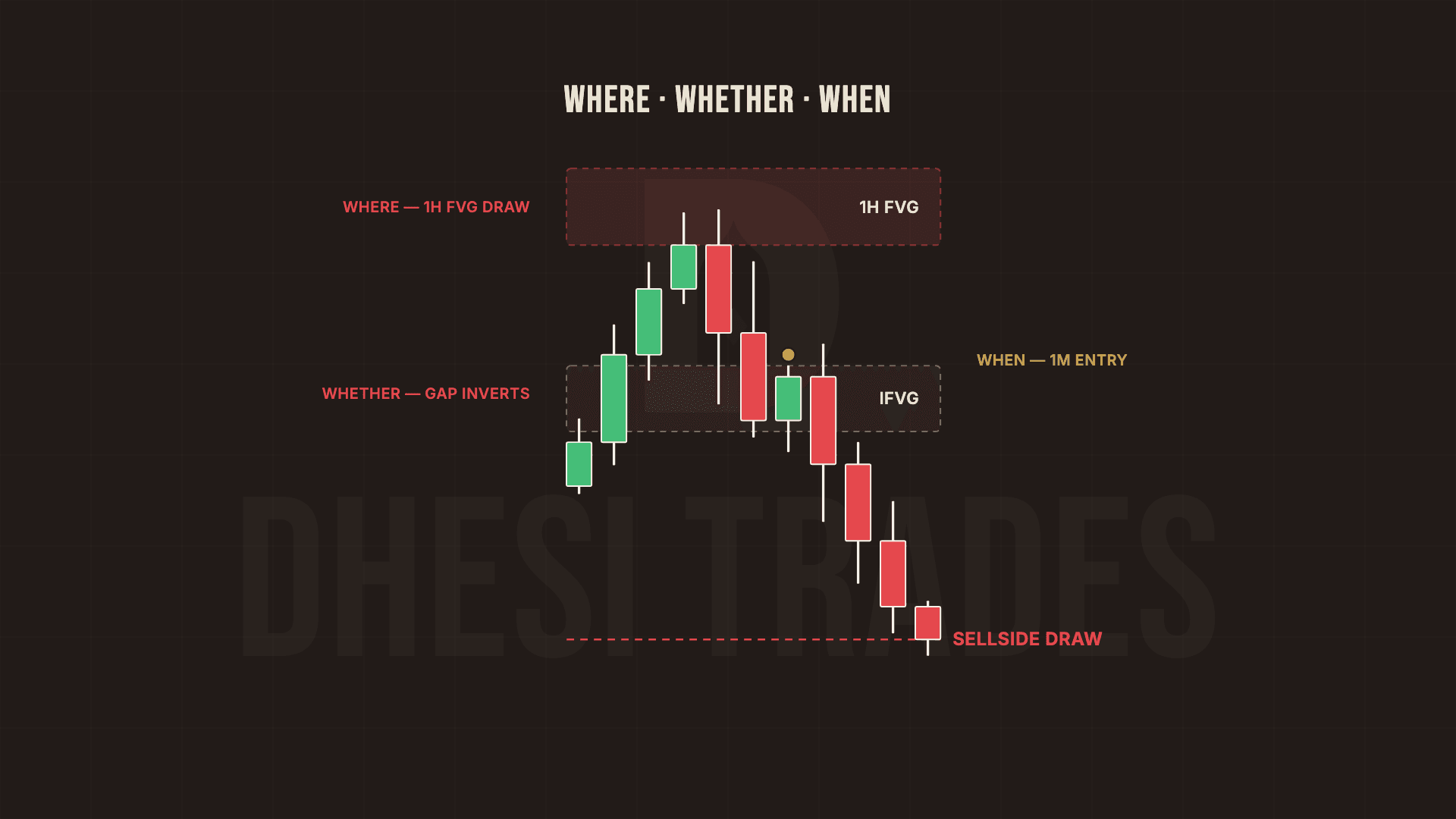
- The higher timeframe (4-hour, 1-hour) answers WHERE. Which PD array is price respecting, and which pool of liquidity is it drawing toward? This is the tide. Nothing below matters until this is marked.
- The middle timeframe (15-minute) answers WHETHER. Does the reaction at the higher-timeframe level actually confirm? For me that confirmation is almost always a fair value gap inversion. No inversion, no validated idea.
- The lower timeframe (1 to 5-minute) answers WHEN. With the idea confirmed above, the lower timeframe exists for one thing only: the entry trigger and the tight stop behind it.
Where, Whether, When
 Dhesi Trades
Why bottom-up trading fails
Watch the 1-minute in isolation and every session looks like fifty opportunities. Inversions print constantly on the lower timeframes. Most of them are against the higher-timeframe delivery, which means most of them are traps. The comfort of the fast chart is false comfort: plenty of candles to react to, no context to filter them.
Trading bottom up means taking a 1-minute signal and then hoping the hourly agrees. Trading top down means the hourly already agreed before the 1-minute was allowed to matter. Same entry, completely different probability.
The chain in practice
This cascade is the same one running inside every setup I have written up:
- In the V4 model, the 4-hour fair value gap is the WHERE, the 15-minute gap is the WHETHER, and the 1-minute inversion is the WHEN.
- In the SMT validation, the divergence at the higher-timeframe level leans me, the 15-minute inversion confirms, and the lower timeframe triggers.
- In the New York open playbook, the overnight 1-hour gap and the week's lows are the WHERE, and the change in the state of delivery is the lower-timeframe WHEN.
Different setups on the surface. The same confirmation chain underneath.
- Start on the higher timeframe. Mark the PD array in play and the draw on liquidity.
- No higher-timeframe level, no trade idea. Do not open the 1-minute yet.
- Price reaches the level. Drop to the 15-minute and wait for the inversion.
- The inversion confirms the idea. Only now does the lower timeframe matter.
- Drop to the 1 to 5-minute for the trigger. Entry at the array, stop behind the structure.
- If any link in the chain is missing, the setup does not exist. Stand down.
When the chain is broken
- A 1-minute signal with no higher-timeframe level behind it. That is noise, not confluence. Skip it.
- The 15-minute never inverts. The idea was never confirmed. A level plus hope is not a setup.
- The timeframes disagree. Hourly delivering higher, 1-minute printing shorts. The higher timeframe wins. Stand aside or trade with it.
- You built the story bottom up. If the entry came first and the context came after, you are rationalizing, not confirming.
Bottom line
The market is fractal, and that only helps you if you read it in order. The higher timeframe picks the zone and the destination, the 15-minute inversion turns the idea into a confirmed setup, and the lower timeframe turns the setup into an entry with a tight stop. Where, whether, when. Run the chain top down every time and the 1-minute chart stops being a slot machine and starts being a trigger.
The full breakdown is on X, and the cascade gets applied live on the stream every weekday morning.
Quick check
Three questions, straight from this article. See if it stuck.
0 of 3 answered