
Quick answer
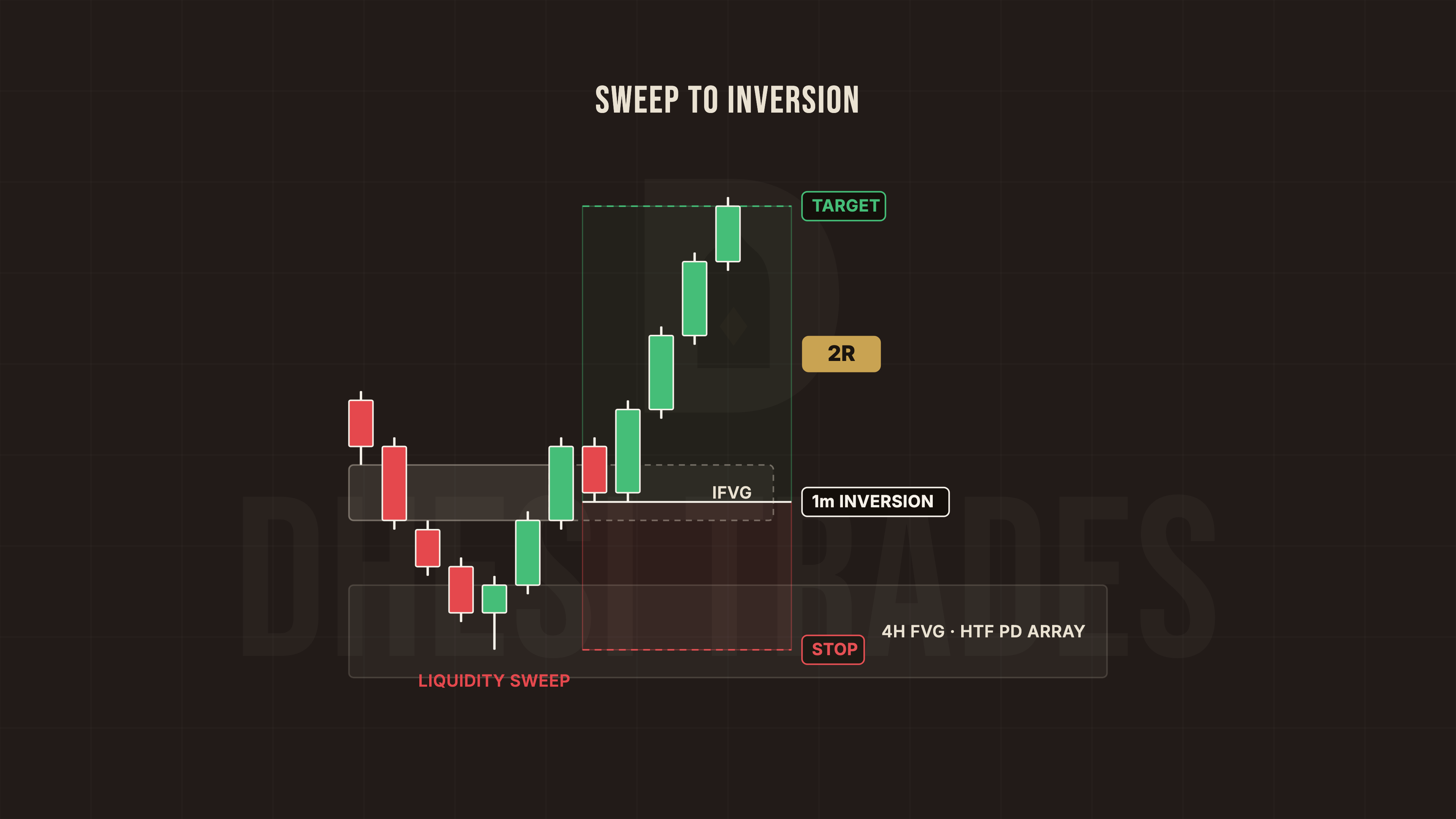
One model, traded the same way every day. A liquidity sweep into a higher-timeframe PD array (my 4-hour fair value gap), a retrace into a 5 or 15-minute gap, and a 1-minute inversion for the entry. Sweep, retrace, inversion. Then I let it run to the opposite liquidity.
Introduction
This is the model I lean on most. I call it v4 because I have refined the same idea over and over until it got this simple. It is not ten setups. It is one read, repeated.
The pieces: a liquidity sweep into a 4-hour fair value gap as the higher-timeframe gravity, a retrace into a 5 or 15-minute gap, and a 1-minute inversion as the trigger. Stack them in that order and the trade comes to you.
Liquidity sweep, higher-timeframe PD array, retrace into a 5 or 15-minute fair value gap, and take the 1-minute inversion. That is as simple as I can explain it.
Kevin Dhesi · @dhesi_trades
How the model reads on the chart
Price sweeps the liquidity, taps the 4-hour gap, then expands back the other way. My job is to wait for the retrace into a lower-timeframe gap and let the 1-minute inversion trigger me in.
Sweep to Inversion
 Dhesi Trades
The playbook
- Liquidity sweep into the HTF PD array. My anchor is a 4-hour fair value gap. In discount I am hunting longs, the opposite for shorts.
- Retrace into a 5 or 15-minute FVG. The move off the array leaves a gap. Wait for price to come back into it.
- The 1-minute inversion is the entry. The gap inverts on the 1-minute, you enter, stop goes below the invalidation.
- Target the opposite liquidity. Buyside for longs, sellside for shorts. On this one it ran about 3.2R.
Two ways I take the entry
- Futures. I wait for the move up off the array, let it create the 5 or 15-minute gap, and take the 1-minute inversion on the retrace. This is the clean version.
- Options (0 DTE). When I am very confident in the system and the array is obvious, I take the entry straight off the higher-timeframe gap for a zero-day expiry. Same read, a different vehicle.
If the move off the array is too small to leave a clean 5 or 15-minute gap, I do not force it. I take the entry straight up off the array and lean on the inversion.
Does it need SMT?
SMT, the divergence between NQ and ES, is a bonus, not a requirement. If it is there, great, it adds confidence. If it is not, the sweep, the array, and the inversion still carry the trade. Do not skip a clean model just because SMT did not print.
When I skip it
- No higher timeframe gap. Without a 4-hour array to lean on, the sweep is just noise.
- No retrace into a gap. If price runs and never gives the 5 or 15-minute gap back, there is no entry. Wait.
- The inversion never confirms. No 1-minute inversion, no trigger. I do not chase the move.
- I am fighting the higher timeframe. If the trade fades the 4-hour gap, I pass. The array is the gravity.
Bottom line
Sweep, retrace, inversion, target the liquidity. The 4-hour gap gives you the side, the 5 or 15-minute gap gives you the location, the 1-minute inversion gives you the trigger. Take it on futures or as a zero-day option, with or without SMT. Same model, every day.
Want the model in real time? This exact sequence runs on the live stream every weekday morning.
Same thing over and over. Liquidity sweep, higher-timeframe PD array, retrace into a gap, take the inversion. SMT is good if it is there, but it does not have to be.
Kevin Dhesi
Quick check
Three questions, straight from this article. See if it stuck.
0 of 3 answered