
Quick answer
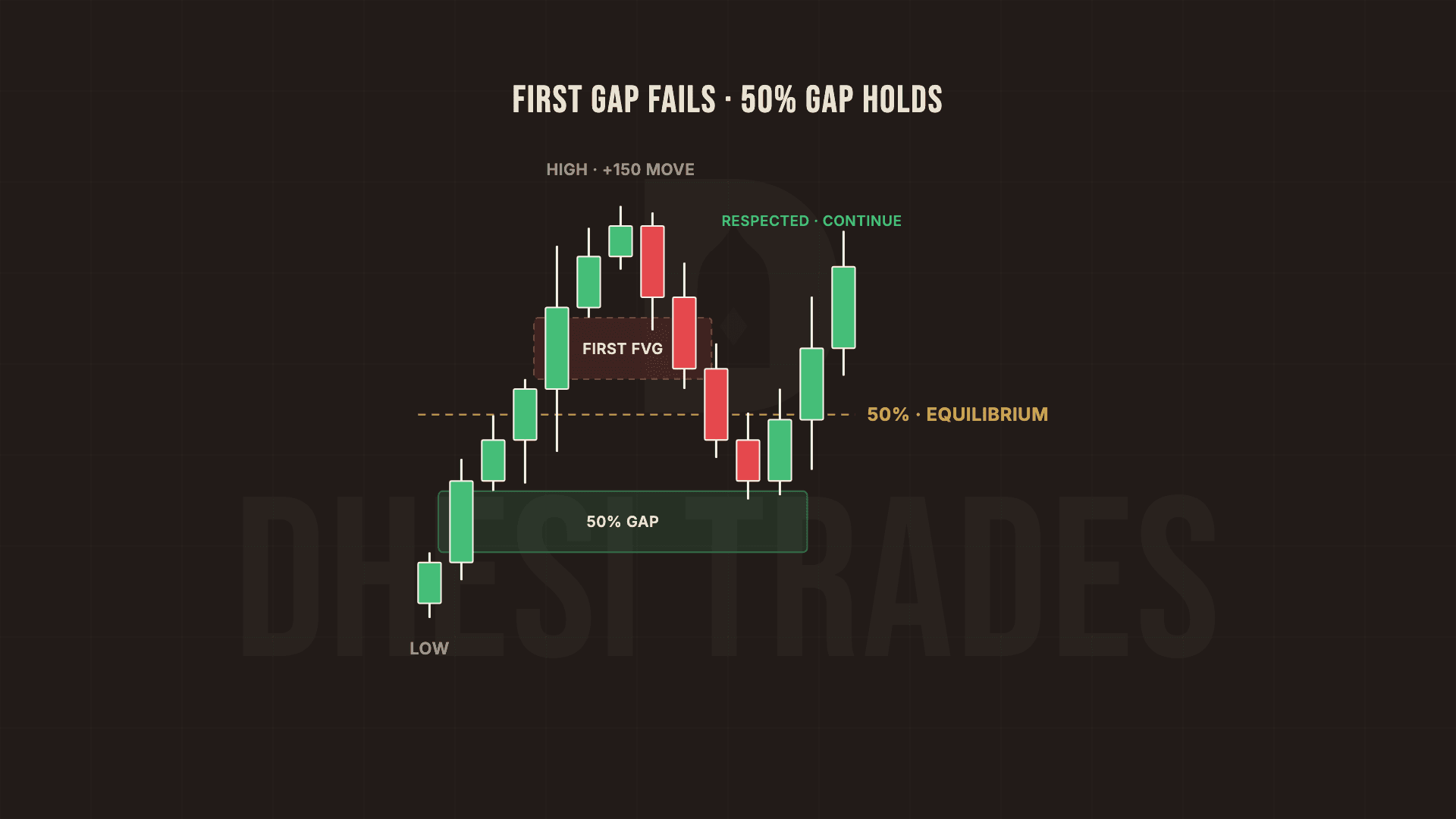
Your fair value gap fails because it is the wrong one. After an expansion move, most traders take the FIRST gap price retraces into, and off a 150-point leg that first gap sits way up in premium. Low probability. Draw the range instead: Fibonacci from the low to the high, find the 50% of the entire move, and take the gap that sits at or below equilibrium. The market respects the discount gap and continues with the trend. The first gap gets you crushed; the 50% gap gets you paid.
Introduction
"Fair value gaps don't work" is one of the most common complaints in this space, and it is almost never the gap's fault. It is a selection problem. The market leaves a trail of gaps behind every expansion, and only some of them are worth trading. Here is the filter, and it takes one Fibonacci.
The setup: AMD and the expansion
The sequence is the usual one: accumulation, manipulation, and a distribution to the upside. The expansion leg is where the gaps get printed. Say the move is 150 points. Price is now stretched, and somewhere behind it are two or three fair value gaps at different depths.
The impatient play is to buy the first gap price touches on the pullback. That gap is the SHALLOWEST one, parked high inside the move.
Premium and discount: the filter
Draw your Fibonacci from the low to the high of the entire leg. The 50% line splits the move into premium above and discount below.
- The first gap on the retrace sits in premium. Buying premium in an up move is paying top dollar for the continuation. Low probability.
- The high-probability gap sits at or below the 50%, in discount. When price trades back into that equilibrium zone, it respects the gap and continues with the trend.
“You don't want to take the first fair value gap, because that is not going to be high probability. Wait for the premium and discount range.
”Kevin Dhesi · @dhesi_trades
First Gap Fails, 50% Gap Holds
 Dhesi Trades
Why the first gap gets taken anyway
Impatience. The retrace starts, the first gap is right there, and sitting on your hands while price walks past an "obvious" entry feels like missing out. So the trade goes on, the gap fails, and the conclusion becomes "fair value gaps don't work."
“Traders get impatient. They take the first fair value gap they see and they get crushed, and wonder why fair value gaps don't work, when it's simply a matter of waiting for that discount range.
”Kevin Dhesi · @dhesi_trades
- Identify the expansion leg: accumulation, manipulation, distribution, then the move.
- Skip the first gap price retraces into, especially off a big expansion. It lives in premium.
- Draw the Fibonacci from the low to the high of the entire leg.
- Mark the 50%. Above it is premium, below it is discount.
- Trade the fair value gap at or below equilibrium, in the direction of the trend.
- If price never reaches the discount gap, there is no trade. Missing a move costs nothing.
When even the 50% gap is not enough
- Counter-trend gaps. A discount gap against the delivery is still a fade. The filter assumes trend continuation.
- No expansion behind it. Gaps inside chop are noise; the filter needs a real leg to measure.
- A deeper draw below. If unswept liquidity sits just under the gap, expect the run first. The reversal model covers that read.
- No lower-timeframe confirmation. Depth alone is context, not a trigger. The confirmation chain still applies.
Bottom line
Fair value gaps do not fail at random. The shallow ones fail because they sit in premium, and the market has no reason to respect top-of-range prices in an up move. Measure the leg, find the 50%, and let the retrace come to the discount gap. Same trend, same gap logic, completely different hit rate. The patience IS the edge.
The gap basics live in how to utilize fair value gaps, the inversion-specific failure modes in why do some IFVGs fail, and the full read runs live on the stream every weekday morning.
Quick check
Three questions, straight from this article. See if it stuck.
0 of 3 answered